
Industrial Shelving & Mezzanine Floors

Mezzaine-Flooring

Strong Shelving and Mezzanine Floors Start With Engineered Wood

Engineered wood products offer a versatile, cost-effective solution for industrial shelving and mezzanine flooring – two critical components of efficient warehouse and commercial storage systems. Industrial shelving provides organized, accessible product storage, while mezzanine floors unlock underutilized overhead space for additional working or storage areas. Explore APA technical resources for guidance on materials and construction best practices that can help you specify the right panels for your industrial applications.


Wood Structural Panels for Industrial Shelving and Mezzanine Floors

Wood structural panels are an ideal choice for both industrial shelving and mezzanine flooring, offering a range of grades and thicknesses that can be matched to load requirements – delivering structural performance and versatility at a competitive cost.

Building Industrial Shelving with Engineered Wood

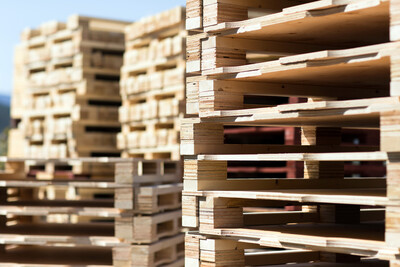
  • Industrial shelving is a key component of modern materials handling systems. It offers the simplest, most economic way to efficiently organize, store, retrieve and display goods.

  • Wood structural panels are the ideal shelving material for many situations, because the grade and thickness can be selected to match the particular application – i.e., thicker panels for heavier loads and thinner, less expensive panels for lighter loads.

  • Cutting: For best results, use a carbide tipped Alternate Top Bevel (ATB) saw blade to cut wood structural panels for industrial shelves. Backing the panel with scrap material and feeding it through slowly helps avoid chipping.

  • Edge treatment: In most industrial applications, no special edge treatment is required for structural panel shelving. However, for appearance or uses where panel edges may need protection from careless loading procedures, edges may be chamfered or protected with stock wood half-round or standard metal or plastic edge banding.

  • Finishing: Wood structural panels will accept any standard wood finish if the surface is clean and the manufacturer’s directions are followed. For durability on frequently cleaned surfaces, use washable enamels or high density overlay (HDO) plywood. In situations where panel shelves may be exposed to unusual edge damage or abrasive wear on their surfaces, they can be economically covered with expendable hardboard, thin sheet metal or other protective surfacing.

Building Mezzanine Floors with Engineered Wood

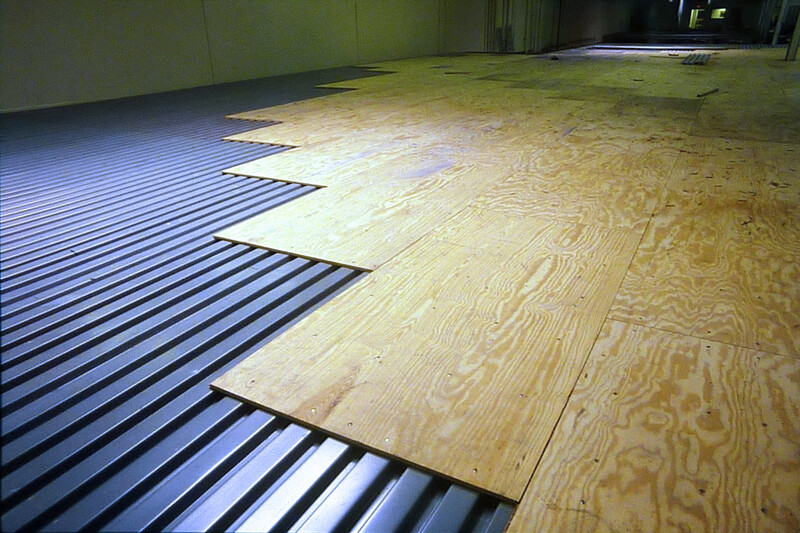
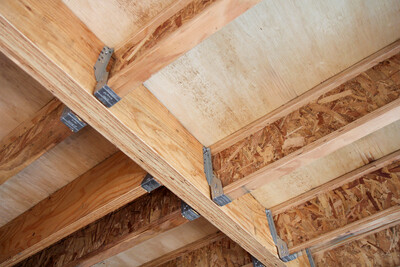
  • Mezzanine floors are used in a broad range of commercial and industrial structures. They are most often designed to support heavy loads. They can also be used to carry pallet jacks or carts so that unused overhead space can become low-cost working warehouse space.

  • A variety of finish flooring can be used on mezzanine floors. In some cases, bare floors can be satisfactory. However, a wearing surface should be provided to resist crushing of floors subject to hard wheel or caster traffic. An expendable layer of panels or a dense wear surface, such as tempered hardboard, should be used if wheels are small, hard or heavily loaded.

  • For information about specifying APA trademarked panels for mezzanine decks, including span ratings for uniformly loaded areas and pallet jack loads, refer to APA’s Materials Handling, Form M200.

  • For more information about caster loadings on plywood, refer to APA’s Caster Loadings on Plywood, Form X227.


Top Questions from the Field

Are edges required to be sealed?

In most industrial applications, no special edge treatment is required for structural panel shelving. For appearance or uses where panel edges may need protection from loading procedures, edges may be chamfered or protected with stock wood half-round or standard metal/plastic edge strippings.

For more information, refer to APA’s Materials Handling, Form M200.

Do I need to cover a mezzanine floor?

A wearing surface should be provided to resist crushing of floors subject to hard wheel or caster traffic. An expendable layer of panels or a dense wear surface, such as a tempered hardboard, should be used if wheels are small, hard or heavily loaded.

For more information, refer to APA’s Materials Handling, Form M200.

Have a Specific Question?

Ask the APA Help Desk