How to Read an APA Trademark Stamp

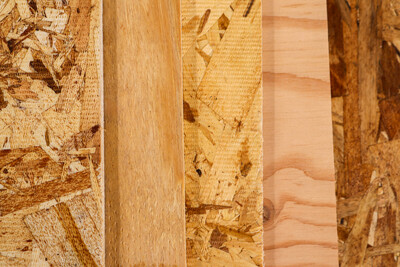
Multi-Products-Plywood-OSB-Trademark

The Industry’s Mark of Trusted Quality

What does the APA trademark stamp represent?

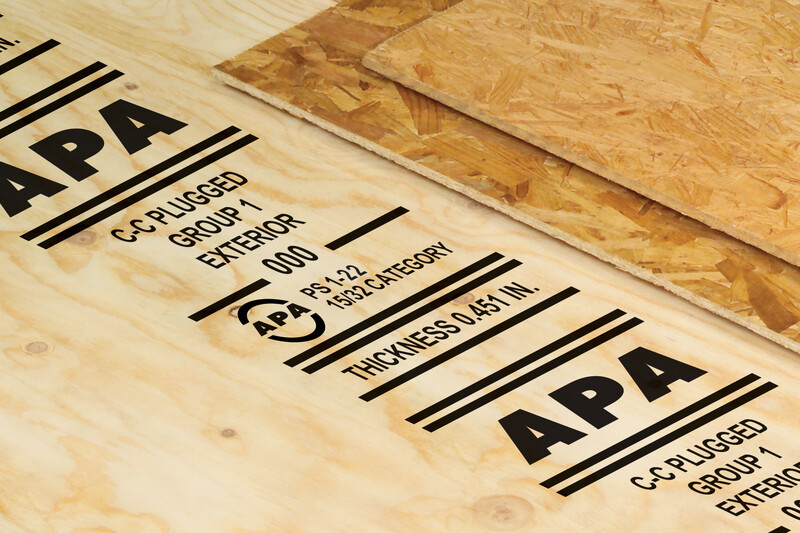
When you specify engineered wood products, one mark makes the difference between assumption and assurance: the APA Trademark. Appearing on APA-certified wood structural panels, engineered lumber, mass timber and other engineered wood products manufactured by APA members. This mark is the building industry's most recognized symbol of independent, third-party quality verification, confirming that the product has been manufactured, tested, and qualified to rigorous performance standards.

APA is a nonprofit trade association whose trademark program operates as a true third-party quality system—administered independently from the manufacturing and sale of any individual product. When the APA trademark stamp appears on a product, it means the manufacturing mill is subject to APA's ongoing quality auditing program and continuous oversight that keeps product performance consistent from mill to jobsite.

Architects, engineers, specifiers, contractors, and code officials around the world look for—and specify by name—the APA trademark as their assurance that the product will perform as designed, every time.

Performance ratings and the APA trademark: What are they and why do they matter?

APA performance ratings are designations assigned to engineered wood products that have been evaluated and qualified under recognized standards, including PS 1, PS 2, and APA's PRP-108, among others. They communicate a product's structural capabilities, appropriate applications, and the manufacturing requirements it has been verified to meet.

A performance rating is not self-assigned. It is earned through a rigorous qualification process and maintained through APA's continuous quality auditing program, including unannounced plant inspections at every participating mill. For building professionals, this means confidence at every project stage, from design and specification through construction and code inspection.

Multi-Products-Plywood-Oriented-Strand-Board


How to Read the APA Trademark Stamp

The APA trademark stamp is more than a quality mark; it’s a compact technical profile of the product it appears on. Every element encoded in the trademark carries specific, actionable information about the panel's performance characteristics, applicable standards, and appropriate end uses. Knowing how to read it means knowing exactly what you have in hand before a single fastener is driven.

Find product-specific trademark examples and additional guidance on specifying and installing engineered wood products on the engineered wood product detail pages.

View Engineered Wood Products

What’s included in an APA panel trademark stamp?

TM-APA-Panel-Callouts
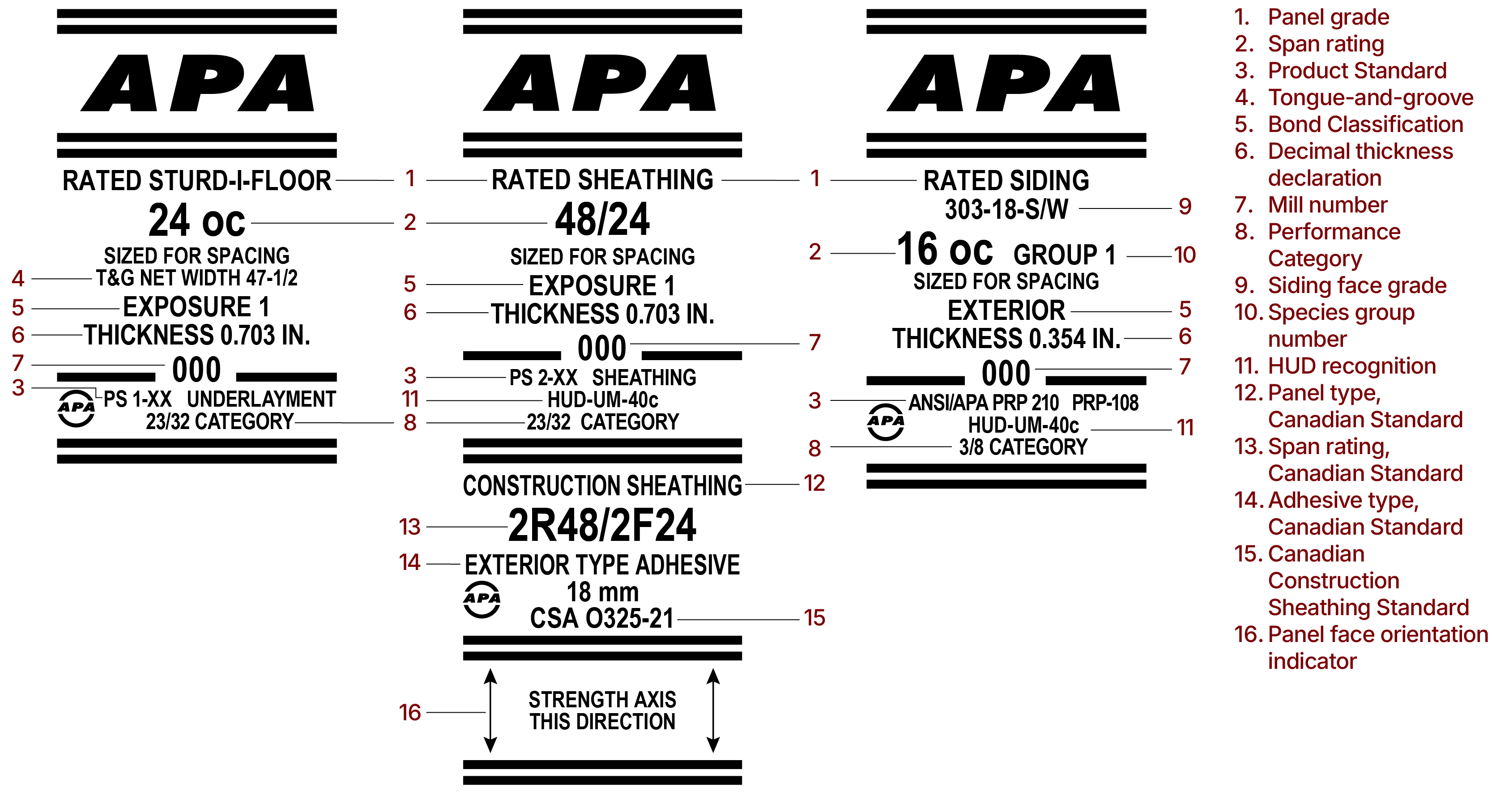
  1. Panel Grade — The term “grade” may refer to panel grade or veneer grade. Panel grades are generally identified in terms of the veneer grade used on the face and back of the panel (e.g., A-B, B-C) or by a name suggesting the panel’s intended end use (e.g., APA RATED SHEATHING, APA RATED STURD-I-FLOOR®, APA RATED SIDING, UNDERLAYMENT).

  2. Span Rating — Two numbers separated by a forward slash. The left-hand number is the maximum recommended center-to-center spacing for supports in inches when the panel is used for roof sheathing with long dimensions across supports. The right-hand number is the maximum center-to-center spacing of supports in inches when the panel is used for subflooring with the long dimension across supports. The span rating on APA RATED STURD-I-FLOOR, underlayment, and APA RATED SIDING panels appears as a single number indicating center-to-center stud spacing. The span ratings for APA RATED STURD-I-FLOOR and underlayment panels, like those for APA RATED SHEATHING, are based on application of the panel with the long dimension or strength axis across three or more supports.

  3. Product Standard — An industry product manufacturing or performance specification. Voluntary Product Standard PS 1, Structural Plywood, was developed cooperatively by the plywood industry and the U.S. Department of Commerce. Voluntary Product Standard PS 2, Performance Standard for Wood Structural Panels, establishes performance criteria for specific designated construction applications. ANSI/APA PRP 210, Standard for Performance-Rated Engineered Wood Siding, was developed by APA under the national consensus process of the American National Standards Institute (ANSI) to provide qualification and marking requirements during manufacture. APA PRP-108, Performance Standards and Qualification Policy for Wood Structural Panels, was developed by APA to provide qualification and marking requirements on APA RATED SIDING products.

  4. Tongue-and-Groove — A system of jointing in which the rib or tongue of one member fits into the groove of another. Tongue-and-groove edges can eliminate the need for blocking beneath panel edges for support.

  5. Bond Classification — Exposure ratings for APA wood structural panels may be Exterior or Exposure 1. The classifications are based on the severity and duration of weather and moisture exposure the panels are designed to withstand, and the wood materials and adhesives used in manufacture.

  6. Decimal Thickness Declaration — This number lists the thickness of the panel in decimal format. This value is generally at or near the lower tolerance specified in the appendix of PS 1 or PS 2.

  7. Mill Number — Manufacturing mill identification number.

  8. Performance Category — A panel designation related to the panel thickness range that is linked to the nominal panel thickness designations used in the International Building Code (IBC) and the International Residential Code (IRC). Find additional information on the historical derivation of Performance Category expression of panel thickness labeling requirements in APA publication Panel Thickness Tolerances and Labeling, Form TT-054.

  9. Siding Face Grade — Grade identification of siding face, based on number of repairs and appearance characteristics.

  10. Species Group Number — Classified according to strength and stiffness under manufacturing standard PS 1 into Groups 1 through 5. Group 1 woods are the strongest, Group 2 second strongest, and so on. Typically used when no span rating is noted.

  11. HUD Recognition — Recognition of wood-based performance-rated panels is contained in Use of Materials Bulletin UM-40c.

  12. Panel Type, Canadian Standard — Some APA panels are manufactured to both U.S. and Canadian standards, and carry a dual mark, as shown in the RATED SHEATHING mark above. Other panels may carry a single mark for either the U.S. or Canadian standard.

  13. Span Rating, Canadian Standard — Span rating and end-use designation for use in Canada. In the Canadian span marking, the “R” signifies roofs and the “F” represents floors: 1F for single floor and 2F for subfloor.

  14. Adhesive Type, Canadian Standard — Adhesive type is required by Canadian building codes. Bond classifications Exterior and Exposure 1 meet Exterior Type Adhesive according to CSA O325.

  15. Canadian Construction Sheathing Standard

  16. Panel Face Orientation Indicator


Top Questions About the APA Trademark

What does Sized for Spacing mean on the APA Trademark Stamp?

SIZED FOR SPACING is a notation often found in APA Rated Sheathing, APA Rated Sturd-I-Floor, and APA Rated Siding trademarks, indicating that the manufacturer has produced the panel to a size slightly less than the traditional nominal 48 inches by 96 inches. This is done to facilitate proper panel spacing during construction. The use of the notation is not required when a panel is so manufactured, but some manufacturers use the notation as a courtesy to the customer.

Find additional guidance in APA’s publication Technical Topics: Sized for Spacing, Form TT-055.

What does “Mill Certified” on my panel mean?

“Mill-certified” panels are panels that have not been subject to testing and inspection by a quality inspection agency, such as APA, and therefore do not carry a quality inspection agency trademark. The performance attributes of such panels are unknown to APA. Contact would need to be made with the manufacturing mill for information. Because certification by an approved third-party quality inspection agency is a requirement of the building codes for structural panels, “mill-certified” panels are not recognized for construction applications governed by building codes.

Find additional guidance in APA publication Technical Topics: Wood Structural Panel Identification, Form TT-013.

Have a Specific Question?

Ask the APA Help Desk